


 Users Today : 861
 Users Yesterday : 2594
 This Month : 41961
 This Year : 520931
 Total Users : 1952961
 Views Today : 1606
 Total views : 9203400
 English
 German
 French
 Italian
 Spanish
 Polish
 Croatian
 Czech
Czech Hungarian
 Norwegian
 Dutch
Dutch Danish
 Swedish
 Chinese (Simplified)
 Chinese (Traditional)
 Japanese
 Thai
ThaiAudio in the change of time
 In early 1940’s first attempts to create Stereo sound have
been made by Disney, the real stereo sound has been
attempted to broadcast in 1940’s too however with mediocre
success. The first really usable results came up in 1969.
In this time most music has been recorded in true stereo and even movie theaters were able to show features in stereo.
But why am I babbling about audio channels and the like? The reason for this is, what our modern audio has become to in the last 50 years. While stereo could succeed as sole true room-filling audio, in 1974 JVC has announced discrete quadrophonic audio which should provide you with 4 discrete channels. In real it was two stereo sources combined as multichannel audio still didn’t exist. The base for quadrophony were 2 discrete stereo recordings from front and rear recording positions. Ingenious for that time! Another step was Surround audio from Dolby enhancing the Quadrophony by an additional center speaker. The discrete LFE channel was then not provided but rather built with a lowpass filter from the front stereo. Dolby introduced Dolby Surround (4.1) in the late 1970’s
It should take about 15 years until the next hurdle, namely Dolby Digital should have been released and in 1992 Batman’s Return was the first official movie feature that was presented in 5.1 channel audio. A vast improvement in roomfilling surround. 6 discrete channels of which one is the LFE (Low Frequency effect) channel, thus the .1 as it is no full spectrum audio channel anyways.
in 1994 Sony tried to introduce SDDS as a concurring audio format against Dolby Digital, however with very limited success. The advantages of SDS were 14 discrete channels (13.1 setup) providing a number of effect channels and of course Front, Rear and side channels. However the SDDS system seemed to be too expensive for most cinemas so it has not been further developed and finally dropped by Sony.
In 1999 6.1 and 7.1 audio was released. Also it was Dolby who brought out this enhancement. 6.1 means Front Center, Left, Right and Rear Center, Left, Right plus one discrete LFE channel. 7.1 is a rather different setup which is typically a 5.1 audio setup with left and right effect channels nested between the center and the corresponding main front channel. It is by now the most common audio format for blu-ray discs (and the maximum, an AVC-HD stream could handle). Right to the millennium change, DTS brought out the uncompressed variant of 6.1 and 7.1 surround sound.
Till now, the formats have only been improved (32Bit audio depth, 192KHz resolution) by expanding the maximum bandwidth (up to 6MBit/s) for the audio stream. They’re labelled Dolby TrueHD and DTS-HD which even comes with a whopping 24.5 MBit/s (imagine that the common AVC-HD stream with Full-HD resolution provides 40 MBit/s at maximum!).
However it seems as if the computer industry plans to expand the audio capability for USB(!)-Devices by far more than current audio codecs seem to be able to handle. According to the document (337 pages) Download “USB AV Revision V1.0” USB_AV_Specification_Rev_1.0.zip – Downloaded 5935 times – 11.53 MB that describes the new AV-Function for USB a setup with up to 51 channels (of which 8 are vibration unit channels and two are headphone channels) leave you there with your wildest dreams! At least 41 channels are discrete. A figure should give you an idea of what’s coming up to us in the near future (click to enlarge):
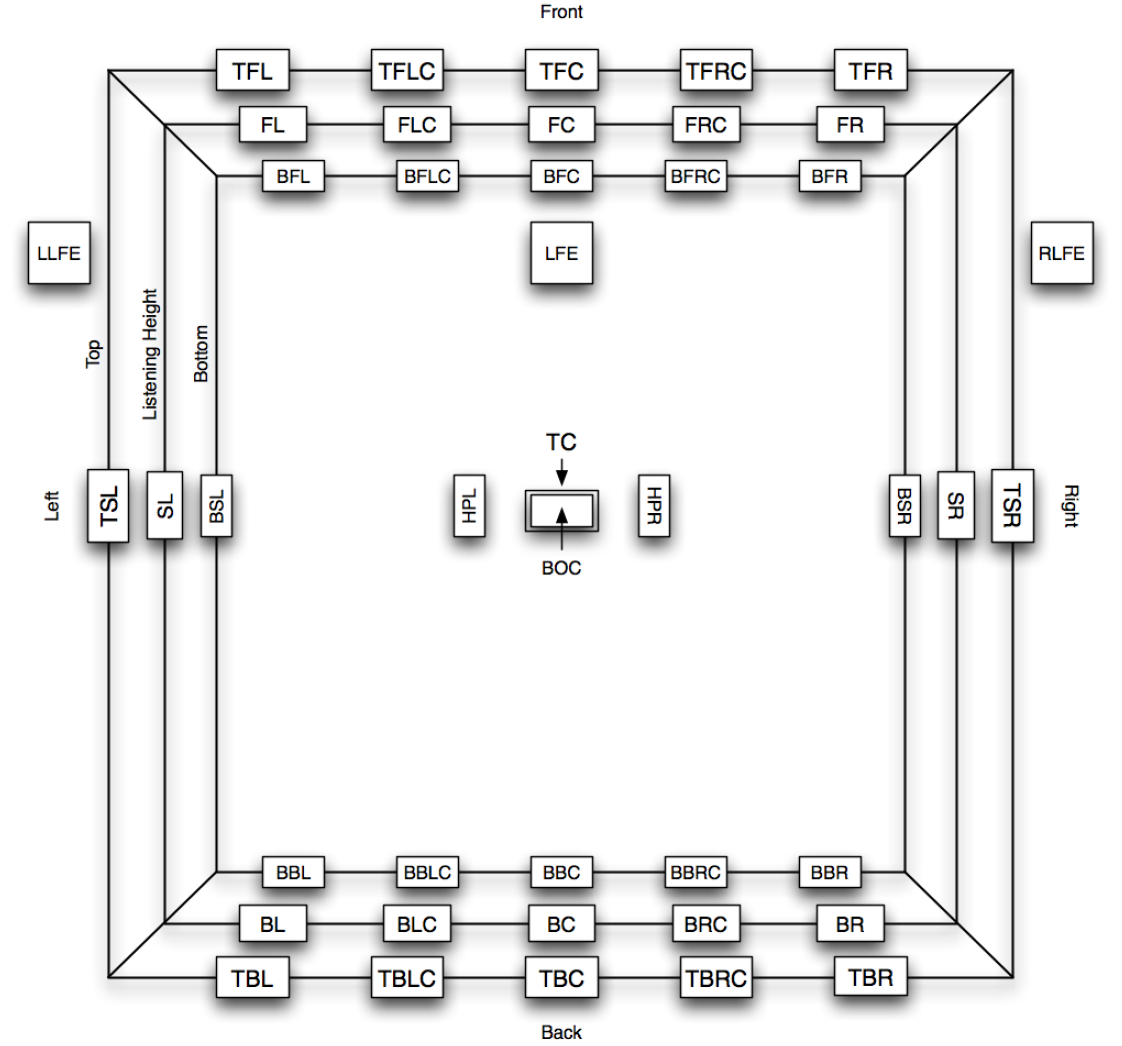 The figure does not include the vibration channels whatsoever. But they’re well imaginable to be positioned. In case you wonder what the letters inside the single channel boxes mean, here’s the according table to it:
| Channel # | Short code | Description | Setup |
| 1 | FL | Front Left | 2.1 |
| 2 | FR | Front Right | 2.1 |
| 3 | FC | Front Center | 5.1 |
| 4 | SL | Surround Left | 7.1 |
| 5 | SR | Surround Right | 7.1 |
| 6 | BL | Back Left | 4.1 |
| 7 | BR | Back Right | 4.1 |
| 8 | BC | Back Center | 6.1 |
| 9 | FLC | Front Left Center | 9.1 |
| 10 | FRC | Front Right Center | 9.1 |
| 11 | BLC | Back Left Center | 13.1 |
| 12 | BRC | Back Right Center | 13.1 |
| 13 | LFE | Low Frequency Effect | 2.1 |
| 14 | LLFE | Left Low Frequency Effect | 7.2 |
| 15 | RLFE | Right Low Frequency Effect | 7.2 |
| 16 | TC | Top Center | |
| 17 | TFL | Top Front Left | |
| 18 | TFR | Top Front Right | |
| 19 | TFC | Top Front Center | |
| 20 | TSL | Top Surround Left | |
| 21 | TSR | Top Surround Right | |
| 22 | TBL | Top Back Left | |
| 23 | TBR | Top back Right | |
| 24 | TBC | Top Back Center | |
| 25 | TFLC | Top Front Left Center | |
| 26 | TFRC | Top Front Right Center | |
| 27 | TBLC | Top back Left Center | |
| 28 | TBRC | Top Back Right Center | |
| 29 | BOC | Bottom Center | |
| 30 | BFL | Bottom Front Left | |
| 31 | BFR | Bottom Front Right | |
| 32 | BFC | Bottom Front Center | |
| 33 | BSL | Bottom Surround Left | |
| 34 | BSR | Bottom Surround Right | |
| 35 | BBL | Bottom Back Left | |
| 36 | BBR | Bottom Back Right | |
| 37 | BBC | Bottom Back Center | |
| 38 | BFLC | Bottom Front Left Center | |
| 39 | BFRC | Bottom Front Right Center | |
| 40 | BBLC | Bottom Back Left Center | |
| 41 | BBRC | Bottom Back Right Center | |
| 42 | HPL | Headphones Left | |
| 43 | HPR | Headphones Right | |
| 44 | VFL | Vibration Front Left | |
| 45 | VFR | Vibration Front Right | |
| 46 | VBL | Vibration Back Left | |
| 47 | VBR | Vibration back Right | |
| 48 | VFC | Vibration Front Center | |
| 49 | VBC | Vibration back Center | |
| 50 | VSL | Vibration Surround Left | |
| 51 | VSR | Vibration Surround Right |
Dark Blue=Channel that is for Headphones
Dark Gray=Vibration channel – No real audio, Impulse signals as effect improvement.
The Setup column contains the minimum audio configuration to use!
Well… nothing much to say about this except that it is the real audio orgasm if you will say so! However I doubt that there will be any audio codec in the near future to cover such a delicate and complex audio channel layout! At least it’s good to know that the USB consortium is already trying to think about such things for the future. And while HDMI will probably lock up at max 11.2 channels, USB will provide more then!
At least let me conclude this: It is very impressive that someone has thought of such a complex and delicate audio scheme! USB seems ready for the future, when regarding this!
However I have concerns about the necessary hardware for such an immense setup! Imagine 41 channels at 170 watts. Then you know how much power your Amplifier must have to provide all these channels with such power! But I don’t think, such an audio setup is made for the end user but rather for movie theaters!
RATING :
 (1 votes, average: 7.00 out of 7)
 Loading...
TAGGED WITH :Audio , Dolby , DTS , multichannel , Surround , USB

Leave a comment